This post is based on a visit I made to Wrest Park last year, where much of the grounds are still laid out as they were in the early 1700s. Much of this article was previously published on the The Coffee Pot Book Club website.

Wrest Park is a stately home in Bedfordshire with extensive gardens, owned by English Heritage. The house is relatively modern, having been rebuilt in the 1830s. This post concentrates on the gardens, interesting because parts of them are still very similar to the way they were in the 1700s. Most other stately home gardens have been landscaped to more modern, informal designs.
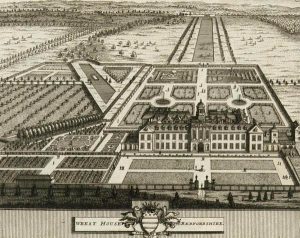
In the 17th century, many owners of stately homes modelled their gardens on those at Versailles –how better to emphasise your status than by replicating the gardens of the French kings? The style was based on formal patterns and straight lines, including parterres (flower beds in symmetrical patterns) and usually a long, straight water feature. This print from 1708 shows the Wrest Park gardens with parterres behind the house. The shaded line stretching into the distance is a canal (a rectangular lake).
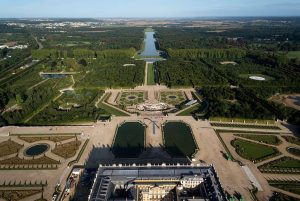
This aerial photo of the gardens at Versailles shows the similarity. The wooded areas beyond the formal gardens were another feature of this type of garden, providing a network of paths and rides, and these were introduced at Wrest Park after the print above was made.
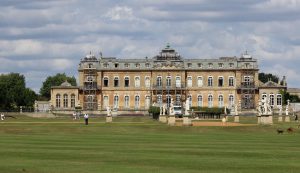
Today, Wrest Park has some more modern flower gardens close to the house, but still has parterres leading to open spaces and then the Long Water bordered on each side by woodland. The first photo in this post shows the view of the house from the distant pavilion just visible in this photo.
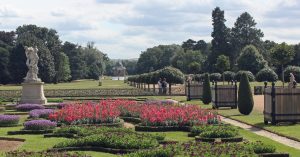
The gardens were used for recreation—entertaining one’s guests in lavish style was another way of displaying wealth and status. The Pavilion at the end of the Long Water was used by hunting parties and sometimes for formal dining. It has elaborate trump d’oeil paintings inside, giving the impression of classical pillars and ornate plasterwork inside the dome.
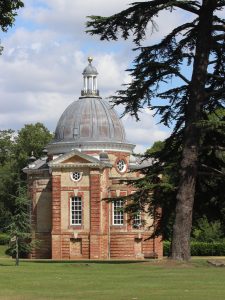
The gardens have other structures, dating from various times, including an orangery, the Bowling Green House (although the bowling green is no longer there), a rustic cottage, and various statues and monuments both in the open gardens and in small clearings along the woodland walks.
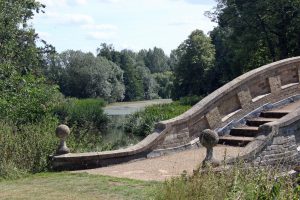
In the mid-18th century, Capability Brown (more on him in a future post) was asked to remodel parts of the grounds into the new English fashion for a less formal, landscape style. He wasn’t allowed to touch the main parts of the grounds, but softened the edges and added an irregular canal around the edges of the woodland.