
We use many phrases in everyday speech that originated in the past and have often changed their meaning. For example, did ‘second rate’ always mean ‘second best’?
First rate or second rate?
Today, ‘first rate’ refers to something top quality, ‘second rate’ or even ‘third rate’ to items of lesser quality. Originally these terms referred to the number of guns on a warship, meaning that a first rate ship was only better than a second rate ship in terms of fire power. It said nothing about the quality of the ship in other respects.

The table shows the rating system used during the Napoleonic Wars. (Information from Wikipedia)
| Rate | Guns | Gun decks | Men |
| 1st | 100 | 3 | 850-875 |
| 2nd | 90-98 | 3 | 700-750 |
| 3rd | 64-80 | 2 | 500-650 |
| 4th | 50-60 | 2 | 320-402 |
| 5th | 32-44 | 1 or 2 | 200-300 |
| 6th | 20-28 | 1 | 140-160 |
1st, 2nd and 3rd rate ships were referred to as ships of the line. There were very few 1st and 2nd rate ships (less than 10 of each), but many more 3rd rate ships. 5th and 6th rate ships were called frigates (although the term was sometimes used quite loosely). Smaller ships such as sloops-of-war, gun-brigs etc were unrated.

Loose cannon
Today, a loose cannon is a dangerously uncontrollable person, and the origin of the phrase is from a cannon that has come loose. Loose from what, you may ask.
The photo below shows the cannon on one of HMS Victory’s gun decks.
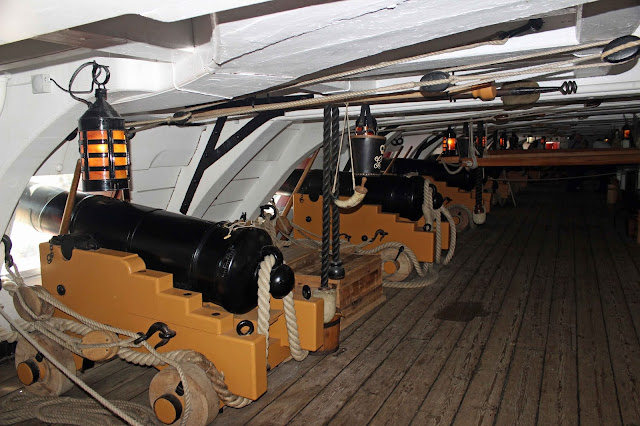
The largest guns on Victory were 32 pounders—this meant the weight of each cannonball was 32 lbs (15 kg). The cannon itself weighed about 56 hundredweight, or nearly 3 tonnes. The thick ropes in the photo are to absorb the force of the recoil when the gun fires, and limit the movement to a few feet. This is enough to allow men to reload it, before the thinner ropes are used to pull it closer to the bulkhead again for the next shot.
A ship at sea is rarely still, and often pitching and rolling violently. I leave you to imagine the damage that could be if the restraining ropes break. With 3 tonnes of metal loose on a rolling deck, a ‘loose cannon’ could be very dangerous indeed.
Nipper
‘Nipper’ is old UK slang for a child, and comes from the boys used to ‘nip’ anchor cables. This image below is of HMS Victory, and you can see from the photo that the rope fastened to the top of the anchor is at least as thick as the man’s arm. Each anchor weighed a couple of tonnes, and the length of cable itself weighed over 4 tonnes.
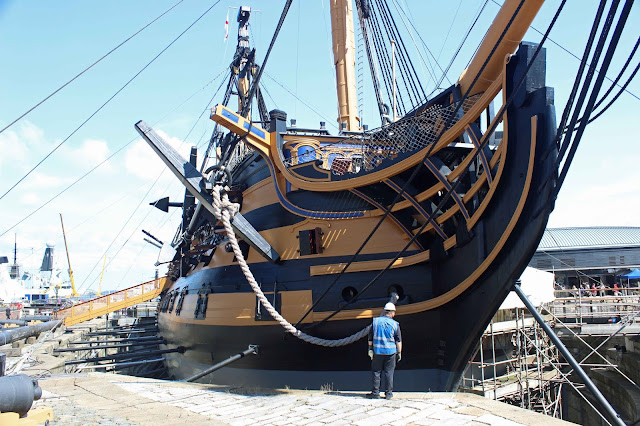
On Victory, the anchor was ‘weighed’ by over 100 men turning two capstans (one mounted above the other on two decks). The anchor cable is far too thick and stiff to be wound around the capstan, so the anchor cable was ‘nipped’ (i.e. fastened) to a thinner, more flexible rope called the messenger cable.

Young boys were responsible for fastening the anchor cable to the messenger cable, then unfastening it again before the anchor cable was fed down to its storage on the orlop deck, and were called nippers.
This video explains in more detail, if you’re interested.
To the bitter end
Not bitter as in lemons…
The photo below shows two sets of bitts on a tall ship (with ropes very neatly coiled). The bitts are the pairs of posts almost hidden by the rope.
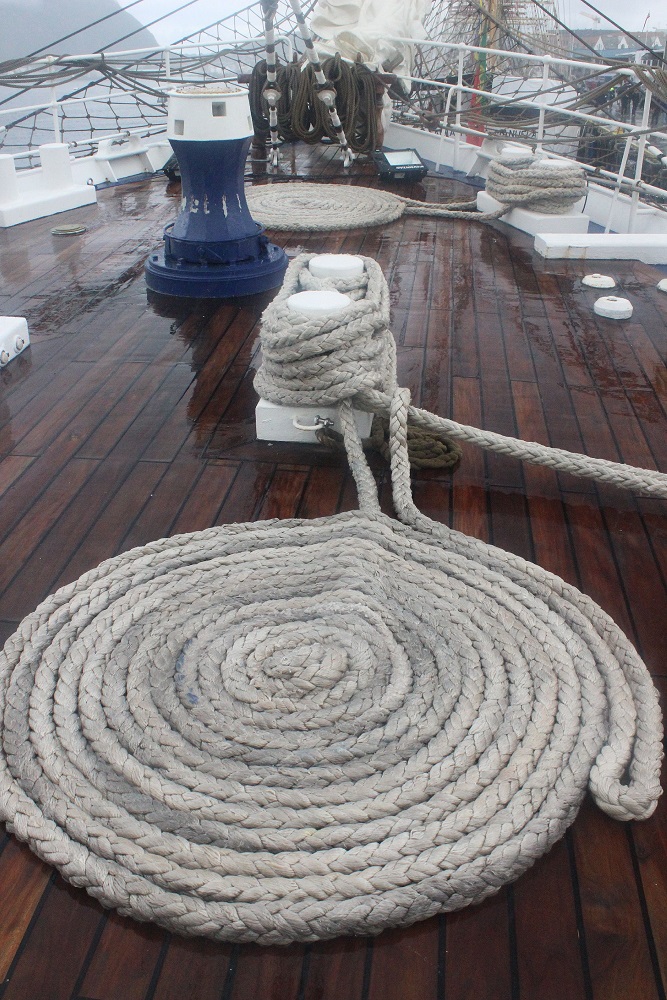
An anchor or mooring cable would have one end wound around the bitts to fasten it to the ship. As the rope was paid out, it would eventually come to the bitter end—the end attached to the bitts. So the bitter end is when you can go no further. This explanation is disputed, but it sounds good enough to me!
Taken aback
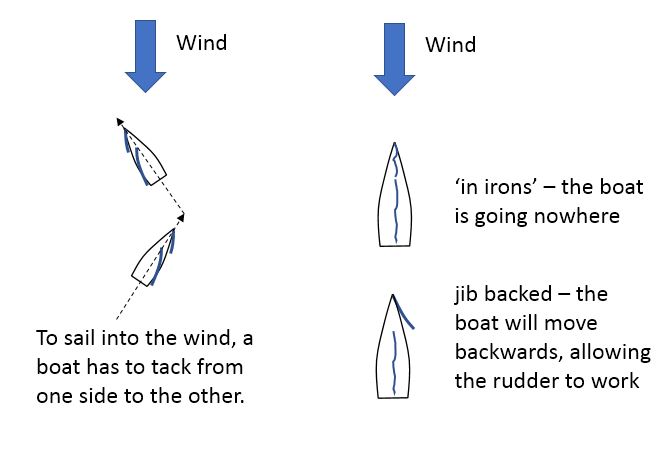
This one’s a bit more complicated. To be taken aback today is to be startled or surprised. The first things to be taken aback were sails, the phrase being first recorded in the 17th century. It means when the wind gets on the wrong side of a sail. This can happen due to a sudden shift in the wind, or due to a course change. If this happens accidently, it is not normally a good thing, but sometimes sails are ‘backed’ on purpose, when a ship heaves to, or if it is caught ‘in irons’. The principles are the same for tall ships like HMS Victory and for sailing dinghies, but it is much easier to explain using the latter!
Heaving to is bringing a ship to a stop in the water without anchoring. A ship being boarded for customs checks, for example, would have to heave to. On a sailing ship, this is done by having some of the sails backed. These backed sails push the ship backwards while others are trying to move it forwards.

A sailing ship wanting to go in the direction the wind is coming from (into the wind) has to tack back and forth. Each time the ship turns, it has to pass though a position where the wind is coming from dead ahead. If the ship doesn’t have enough momentum in its turn, it can get stuck pointing directly into the wind, unable to move or turn further. As the ship is hardly moving the rudder doesn’t work. It is referred to as being ‘in irons’. This is an example of a phrase going from everyday like into shipboard life—a convict in manacles (in irons) cannot move, and nor can a sailing ship in this position.
The way out of this, as I rapidly learned in my dinghy sailing days, is to back the jib. This pushes the boat backwards, giving enough movement for the rudder to work and put the boat in a position where both sails can fill. You then try again, hoping not too many people were watching.
Want to know more? The Phrase Finder website discusses lots of phrases that have nautical origins, and debunks some that seem to be obviously related to the sea but are not.
https://www.phrases.org.uk/meanings/nautical-phrases.html
(This material was originally published on Mary Anne Yarde’s blog: https://maryanneyarde.blogspot.com/)
I have also done a post on some sayings originating from the use of flintlock weapons.


